Some sentences go down smooth. Others stick.
The problem is, most writers can't tell the difference because they're too close to their own work. They read what they meant to say, not what's actually on the page. It's like trying to taste your own cooking while you're making it. Everything seems fine until your dinner guest quietly pushes their plate away and asks if you have any cereal.
The Cadence Problem Nobody Talks About
Here's what happens when all your sentences are roughly the same length. Your reader's brain starts to coast. It's like driving on a perfectly straight highway through Nebraska at 2 AM. Technically you're moving forward, but your consciousness has left the building. The rhythm becomes a drone. A hum. Background noise.
Long sentences can be beautiful, can carry complex ideas, can wind through subordinate clauses and prepositional phrases like a river finding its way to the sea, building momentum and gathering small tributaries of thought until they arrive at some satisfying destination that feels earned. But stack too many of them together and your reader needs a nap.
Then you've got short sentences. They punch. They land. They create impact.
But if every sentence is short? You sound like a telegram. Or a caveman. Or a caveman sending a telegram. Stop. Communicate. Bad. Help.
What Your English Teacher Got Wrong
Remember being told to vary your sentence structure? That wasn't about being fancy. It was about preventing brain death in your audience. Because rhythm isn't decoration—it's the difference between reading and experiencing.
Think about how you actually talk when you're excited about something. You don't use the same sentence pattern over and over like a broken record. You speed up. You slow down. You pause for effect. Sometimes you blurt out a fragment because the complete thought can wait. You create a shape with your words, and that shape communicates just as much as the words themselves.
Writing should feel the same way.
The Invisible Rhythm Track
Every piece of writing has a rhythm whether you planned it or not. It's like how every person has a walk—some people bounce, some people shuffle, some people stride like they're personally offended by the ground. You might not think about your walk, but everyone else notices it.
Your sentence rhythm is your writing's walk.
When you mix up sentence lengths, you create texture. A long, winding sentence that explores every corner of an idea, followed by a short one, creates a natural emphasis. The short sentence lands harder because of the contrast. It's like whispering after shouting. Or shouting after whispering. The change is what your brain latches onto.
Consider this: you can write about the most interesting topic in the world—space pirates, secret underground civilizations, the exact moment someone falls in love—but if your rhythm is flat, it reads like a technical manual. On the other hand, you can write about absolutely nothing and make it compelling if the rhythm pulls your reader along.
Enter the Highlighter
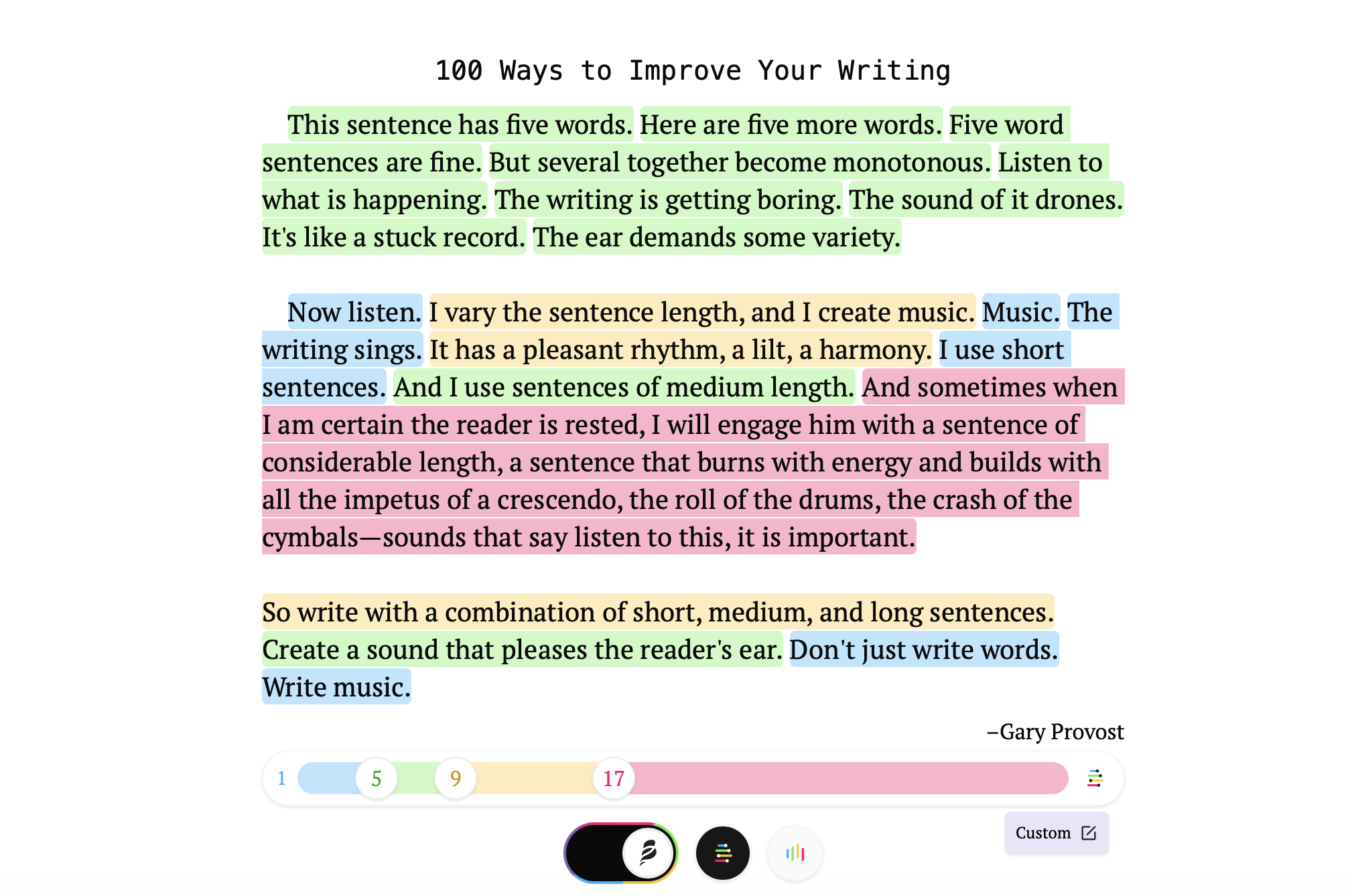
This is where Beampen becomes your writing's X-ray machine. It doesn't care about your intentions or your feelings or how much coffee you drank while writing that paragraph. It just shows you the truth: these sentences are all medium length. These five in a row are all short. This paragraph has zero variation and probably put someone's grandmother into a coma.
You can't fix what you can't see.
The tool highlights sentences based on word count, creating a visual map of your rhythm. Suddenly, you're not guessing. You're not relying on some mysterious "ear" that may or may not be broken. You're looking at your sentence lengths the way a composer looks at sheet music—as patterns that either work together or don't.