You already know that word choice affects emotion. You pick strong verbs and you strip weak adverbs. You hunt for vivid images. Still, something in your writing can feel flat or chaotic even when every word is technically correct.
Often the missing piece is simple. Your sentences are the wrong length for the feeling you want.
Emotion Lives In Rhythm, Not Just In Words
When you read a passage that gives you chills or makes your heart race, you rarely stop and say, “That sentence was fourteen words long.” Yet your body reacts to timing. Short bursts feel different from slow winding lines. Your brain feels the pattern even when you do not name it.
Think about music. Two songs can use the same notes and still feel different because of tempo and rhythm. Writing works the same way. Sentence length is your tempo control. When you change it, you change how a moment feels.
If you never pay attention to length, you still have a rhythm. You just have a random one. The page might drone. It might stutter. It might swing between extremes. You want a rhythm that matches your intent instead.
What Short Sentences Make You Feel
Short sentences feel quick. Direct. Sometimes harsh. They push the reader forward with little time to drift.
Read this:
"She hears a sound outside. The glass shakes. The lights flicker. The dog lifts his head and growls."
Each sentence lands like a step on a staircase. The pace stays tight. You feel alert. You feel the build of tension because you get one clear beat at a time.
You can use this effect whenever you want urgency. A chase scene. A sudden argument. A realization that hits your character like cold water. Short sentences work well when you want the reader to think, “This is not safe. Do not relax.”
There is a limit though. If you keep every sentence short, your prose starts to sound mechanical. You lose nuance and the emotion flattens into noise.
What Long Sentences Make You Feel
Long sentences stretch time. They invite you to linger. They let you sink into a mood, a setting or a thought.
Try this version of the same moment:
“You hear a sound from somewhere behind you, and the faint rattle of glass in the window makes you freeze, while the lights above flicker in a slow, uncertain pulse that turns the room into a place that feels almost unfamiliar.”
Here you feel suspended. The sentence wraps the moment in one long breath. It feels dreamy and uneasy instead of sharp and urgent.
Long sentences help when you want reflection or immersion. You might use them when your character walks through a city at night, notices small details or replays an old memory. The reader drifts with the thought instead of sprinting through it.
Again, there is a limit. A whole page of long winding sentences can feel heavy. Your reader gets tired and may stop caring, even if the idea is strong.
Medium Sentences And The Baseline Of Calm
Most of your writing will sit in the middle. Medium length sentences carry information without pulling attention to themselves. They feel natural, like conversation.
You use them when you need clarity. Explanations. Transitions. Descriptions that should not steal the scene. Medium sentences are the steady walking pace between sprints and slow motion.
If your whole piece is medium though, you lose contrast. The emotional line goes flat. You do not give the reader any sharp turns or gentle drifts. Everything stays at the same level of intensity.
How Contrast Creates Feeling
Emotion does not come from short or long sentences on their own. It comes from contrast. The shift between lengths is what your reader feels.
Look at this simple pattern:
“The evening felt calm. The sun slid behind the houses at the end of the street, painting every window with a last dull glow while traffic thinned and the voices outside faded. Then the glass broke.”
You start with a short sentence that names the mood. Calm. You move into a long sentence that paints it. Then you snap to a short sentence again. That final line feels like a shock because it breaks the rhythm you just built.
When you are aware of length, you can design these turns. You can slow the reader down. You can rush them. You can let them rest right before you cut the ground away.
Using Length To Shape Specific Emotions
To build tension
If you want tension, you can start with medium sentences, stretch into a longer one, then drop into a chain of short ones. The reader feels the squeeze, then the snap.
Calm. Longer line. Short. Short. Short.
The meaning matters of course, but the pattern alone already feels like a heartbeat that suddenly speeds up.
To invite empathy
If you want the reader to feel close to your character, you can linger in slightly longer sentences that track inner thoughts. Then you sprinkle in shorter reactions.
“You remember the night you left home, and the way the porch light turned the air thick and yellow as your father stood without speaking, a whole storm of words packed into the way he held the screen door. You thought you were ready. You were not.”
The long sentence puts you inside the memory. The last short line lands like a soft bruise.
To create calm and trust
If you want calm, you use mostly medium sentences with occasional longer ones. You avoid spikes of very short lines. The rhythm stays smooth. You let the reader breathe.
This works in reflective essays, instructional pieces and quiet scenes between big plot moments. The emotion here is steady attention and gentle interest.
Why You Struggle To Feel Your Own Rhythm
You already have an instinct for this when you read other people. You can feel when a book drags. You can feel when a scene feels rushed. You may even mark specific sentences you love without fully knowing why.
When you look at your own work, your sense of rhythm often goes numb. You know what you meant to say, so your brain fills in the feeling you wanted instead of the feeling you actually put on the page.
This is why your sentences all end up the same length without you noticing. Your eyes glide. Your ear forgives. You tell yourself it sounds fine.
You need a way to see rhythm instead of guessing about it.
How Beampen Turns Emotion Into Something You Can See
Beampen exists for this exact problem. It treats sentence length as a visual pattern, so you can see where your emotion goes flat.
When you paste or write your text in Beampen, every sentence gets a color based on length. Short, medium, long and extra long. You set the ranges yourself, so you can tune them to your style and genre.
In a single glance, you can see if a paragraph is all one color. That usually means all one mood. You can see where you have a wall of long sentences that might feel heavy. You can see the places where you fire off a series of short sentences that might feel choppy.
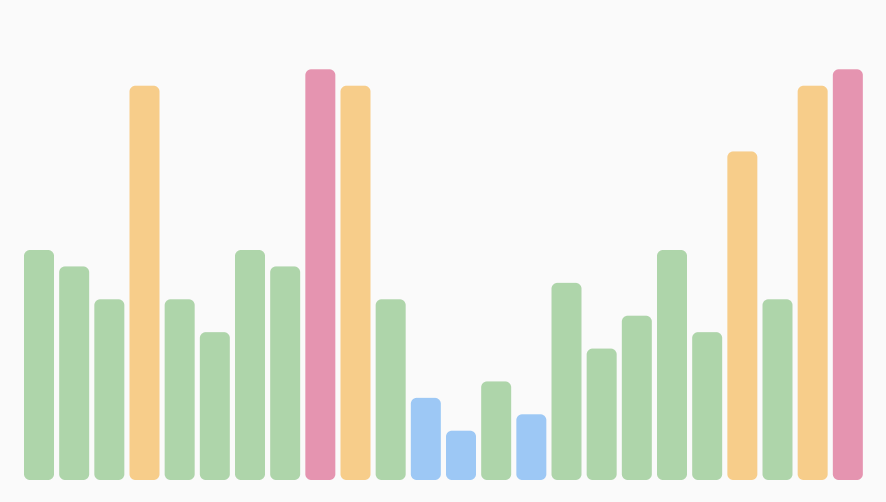
The Rhythm Chart adds another layer. Each sentence becomes a bar. The height of the bar shows how long the sentence is. If the bars march along in a flat line, you know the emotional pulse is also flat. If the bars rise and fall, you know you have variation that can carry feeling.
Instead of thinking, “Maybe this is boring,” you can point at a specific group of sentences and say, “This part needs one sharp break,” or “This section needs one slow breath before the reveal.”
Overcoming Writer's Block With Rhythm Instead Of AI
When you feel stuck, it is tempting to let an AI write a sentence for you. The problem is simple. Each time you let a model decide your rhythm, you give away a piece of your voice. The emotional timing stops feeling like you.
Beampen takes a different path. It will not write for you. It will not guess your next line. Instead, it gives you tools that keep you moving while you stay the author.
If you press the slash key inside Beampen, you can pull up human written sentence starters and custom prompts. You still decide the words, but you do not face a blank page alone. You get a nudge, not a full paragraph that flattens your style.
Once you start writing again, the Flow Coloring and Rhythm Chart react in real time. You see your sentences change color as you type. You see new bars appear. You can literally watch your emotional rhythm grow across the page.
How To Practice Emotional Control With Sentence Length
You do not need to overhaul your entire draft at once. You can start small and build the habit.
Step 1: Pick one scene or section
Choose one page where the emotion feels off. Maybe the scene should be tense but feels flat. Maybe it should be calm but feels busy. Paste it into Beampen or open it in a new file.
Step 2: Look at the colors
Glance at the Flow Coloring first. Are most sentences the same color. Do you see a long streak of one shade. Mark any stretches that feel too uniform.
Step 3: Inspect the Rhythm Chart
Open the Rhythm Chart. Look at the sequence of bars. Are you climbing for a long time without a break. Are you jumping up and down so fast that nothing has weight. Click a bar to jump to that sentence and feel it in context.
Step 4: Edit for feeling, not rules
Now, instead of chasing grammar rules, chase emotion. Ask yourself what the moment should feel like. Then nudge sentence length to match.
- Shorten one sentence where you want a jolt.
- Combine two sentences where you want a slow sweep.
- Break a long sentence in half where you want the reader to catch a breath.
Watch how the colors and bars change as you edit. The visual feedback keeps your focus on rhythm until it becomes second nature.
Your Voice, Your Rhythm, Your Emotion
You do not need AI to tell you what to write. You need a clear view of what you already wrote so you can make confident choices.
Sentence length is one of the simplest tools you have, yet it touches every feeling on the page. When you understand how it works, you can guide your reader through fear, calm, joy and grief with quiet control.
If you want to see your emotional rhythm instead of guessing about it, you can try Beampen today. No AI suggestions. No autogenerated paragraphs. Just your words, your sentences and a clear picture of how they move.